7 min read
Yellow LED light: calming reactive skin, and what light therapy can honestly promise
Yellow LED is a supportive treatment: it calms, it does not transform. What it genuinely brings to red or irritated skin, and how to use it without expecting too much.
By Dr. Achraf Daoud · Published on
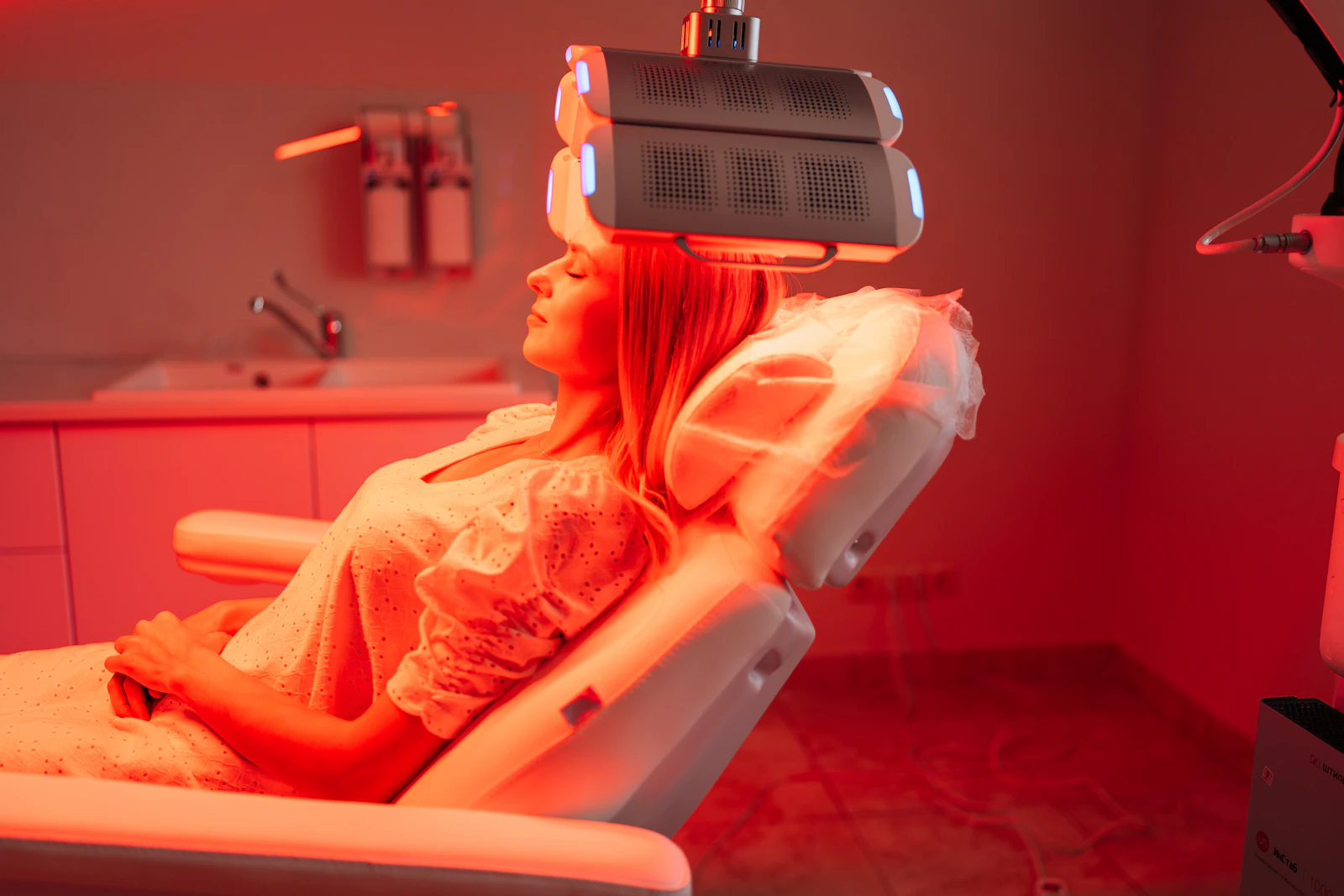
LED photobiomodulation exposes the skin to light of a precise wavelength, with no significant heat and no ablative effect. Yellow light, at around 570 to 590 nanometres, is the one used for its calming effect on red, reactive or compromised skin.
It is a comfortable, painless treatment with no social downtime. It is also a supportive treatment: it accompanies other procedures, it does not replace them. That nuance is the key to being satisfied with it.
How yellow light works
Light is absorbed by molecules inside the cell, notably within the mitochondria. That absorption modulates cellular activity: a reduction in inflammatory signalling and support for repair processes are observed. Yellow penetrates less deeply than red and infrared, but more than blue, which places it at the level of the superficial dermis and the microcirculation.
In practice this translates into skin that is less red, less sensitive and more comfortable after a few sessions. The level of evidence still calls for restraint: clinical studies on yellow are fewer and weaker than those on red, and many concern professional devices rather than home masks.
Where it genuinely helps
- Reactive skin, diffuse redness, a sensation of heat and discomfort.
- After a laser, a peel, microneedling or a session of injections: LED is often offered to support the recovery phase.
- Skin irritated by strong actives, retinoids or acids, during an adjustment phase.
- Maintaining skin comfort in someone with thin, reactive skin, as a course of sessions.
- As an adjunct to medical treatment of rosacea, agreed with the doctor managing it.
What yellow LED does not do
- It does not fill a wrinkle or a hollow: there is no volumising action.
- It does not tighten lax skin: no effect comparable to a facelift, or even to radiofrequency.
- It does not clear pigmentary marks, which call for other lasers and depigmenting treatments.
- It does not destroy visible dilated vessels, which require a vascular laser.
- It does not replace sun protection, which remains the foundation for any reactive skin.

The protocol: frequency, duration, number of sessions
Protocols vary by device, and it is the power delivered that determines how long a session needs to be. The guidance below is indicative and should be adapted by the practitioner to the device used and to your skin.
- Full make-up removal: any residue of make-up, pigment or sunscreen reduces light penetration.
- A session of 10 to 20 minutes, eyes protected, face at the distance recommended for the device.
- Starting rhythm: one to three sessions a week, as a course.
- A usual course of 6 to 10 sessions before assessing the benefit.
- Maintenance afterwards, at a spaced-out frequency, depending on how reactive your skin is.
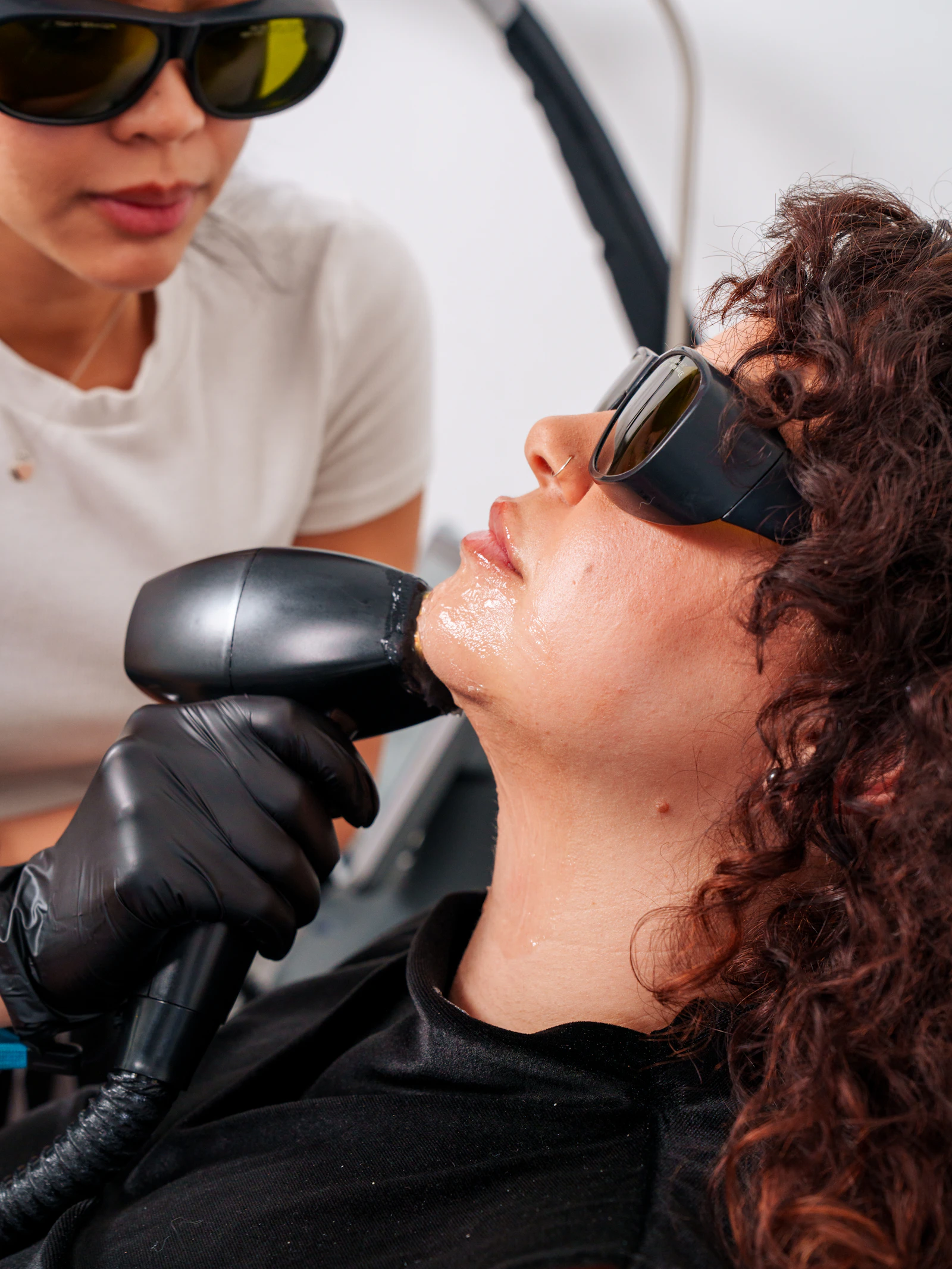
In a post-laser or post-peel pathway, the LED session is often performed straight after the procedure, then repeated every few days through the recovery phase, according to the practitioner's protocol.
Home mask or clinic device
| Criterion | Home mask | Professional device |
|---|---|---|
| Power delivered | Often low, highly variable between models | High and measured, in line with studied protocols |
| Evenness | Uneven depending on mask shape and distance | Wide panel, controlled distance |
| Where it fits | Maintenance between sessions, day-to-day comfort | A structured course, support after a procedure |
| Main limitation | Often a modest result, hard to compare between brands | Requires travel, cost per session |
If you buy a mask, check that the wavelengths are stated precisely, that eye protection is provided and that the device carries a conformity marking. A device that advertises a colour without stating its wavelength or its irradiance makes any serious comparison impossible.
Contraindications and precautions
- Ongoing photosensitising treatment: certain antibiotics, anti-inflammatories, St John's wort, recent isotretinoin. Seek medical advice first.
- Photodermatosis, lupus, porphyria or any other light-triggered condition.
- A suspicious or undiagnosed skin lesion in the area: it must be examined first.
- Photosensitive epilepsy: avoid devices with flashing light.
- Eye protection every time, even though yellow light feels gentle.
- Pregnancy: as a precaution, seek medical advice, even though no specific risk is established.
Yellow LED is a comfort and support treatment. Used well, it leaves reactive skin calmer. Sold badly, it becomes a promise of rejuvenation it cannot keep.

Frequently asked questions
What is yellow LED used for on the face?
It is used to calm reactive skin, reduce diffuse redness and support recovery after a laser, a peel or microneedling. Its action is anti-inflammatory and reparative, with no heat and no social downtime. It is a supportive treatment, not a treatment in its own right.
How many yellow LED sessions before you see an effect?
A course of 6 to 10 sessions, at one to three sessions a week, is the most common schedule before assessing the benefit. Sessions last 10 to 20 minutes. Spaced-out maintenance is then offered depending on how reactive the skin is.
Can you have LED after a laser?
That is one of its most frequent uses: LED is often offered after a laser, a peel or injections to support the recovery phase. The exact protocol, timing and number of sessions, is set by the practitioner who performed the procedure.
Are home LED masks effective?
They generally deliver lower and less even power than clinic devices, so their effect is more modest. They can serve as maintenance between sessions. Check the stated wavelengths, the eye protection provided and the device's conformity marking.