8 min read
Laser hair removal: how many sessions, which laser for your skin, and why nobody should say permanent
Six to ten sessions, a laser chosen for the colour of your skin, and hair that will never respond: a complete look at what laser hair removal can honestly promise.
By Dr. Achraf Daoud · Published on
Laser hair removal uses a beam of light absorbed by the melanin in the hair. The absorbed energy turns into heat, which damages the follicle. For that to work there has to be contrast: a pigmented hair, and skin that is as little pigmented as possible by comparison.
That single principle explains almost everything: why blonde and white hair does not respond, why darker skin needs a specific laser, why a tan is a problem, and why several sessions are unavoidable.
Why several sessions are compulsory
A hair is only destroyed effectively during its growth phase, called anagen, because that is when it is connected to the structure that produces it. At any given moment only a fraction of the hairs in an area are in that phase, the rest being at rest or shedding. One session can therefore only treat part of the stock.
- Expect 6 to 10 sessions in general for a lasting, satisfactory reduction.
- Spacing follows the growth rhythm of the area: about 4 to 6 weeks on the face, 6 to 10 weeks on the body, sometimes longer later in the course.
- Hormone-dependent areas, the face and neck in women, often need more sessions and ongoing maintenance.
- Annual or twice-yearly maintenance sessions are common, especially on the face.
Why we say long-lasting rather than permanent
Follicles that are genuinely destroyed do not grow back. But the body holds dormant follicles that can switch on under hormonal change: puberty, pregnancy, menopause, polycystic ovary syndrome, certain medications. That is why the accurate term is long-term hair reduction.
In practice, most patients achieve a very substantial and stable reduction, with any remaining hair finer and lighter. Promising the total and permanent disappearance of every hair, for life, is not accurate.
Which laser for which skin
| Laser type | Best suited to | Specifics |
|---|---|---|
| Alexandrite 755 nm | Lighter skin types, fine to medium hair | Very strong absorption by melanin, so effective but to be avoided on dark or tanned skin |
| Diode 808 to 810 nm | Light to intermediate skin types, broad use | A good balance of efficacy and safety, large areas treated quickly |
| Nd:YAG 1064 nm | Darker skin types, Black or olive skin | Penetrates deeper while interacting less with epidermal melanin, so safer on pigmented skin |
| Intense pulsed light | Lighter skin types, often non-medical settings | Not a laser: the light is polychromatic and less selective |

The hair that will never respond
The laser targets melanin. A hair that contains little or none does not heat up, and no setting will change that physical fact.
- White or grey hair: no response, the follicle is not reached.
- Very light blonde and red hair: weak to no response depending on pigment content.
- Fine, lightly pigmented vellus hair: inconsistent response, with occasional paradoxical stimulation on some areas of the face.
- In those cases electrolysis remains the only technique able to treat hair whatever its colour, but one hair at a time.
Preparation and precautions
- No waxing, plucking or epilator use for at least 4 weeks before the session: the root must be in place. Shaving, on the other hand, is allowed and even recommended.
- Shave the area the day before or the same day, unless told otherwise.
- No tanning, natural or on a sunbed, and no fake tan in the weeks before and after.
- Declare any photosensitising treatment: certain antibiotics, anti-inflammatories, St John's wort, or isotretinoin for acne.
- After the session, strict sun protection, and no sauna, steam room, chlorinated pool or intense exercise for 48 hours.
Pain, after-effects and contraindications
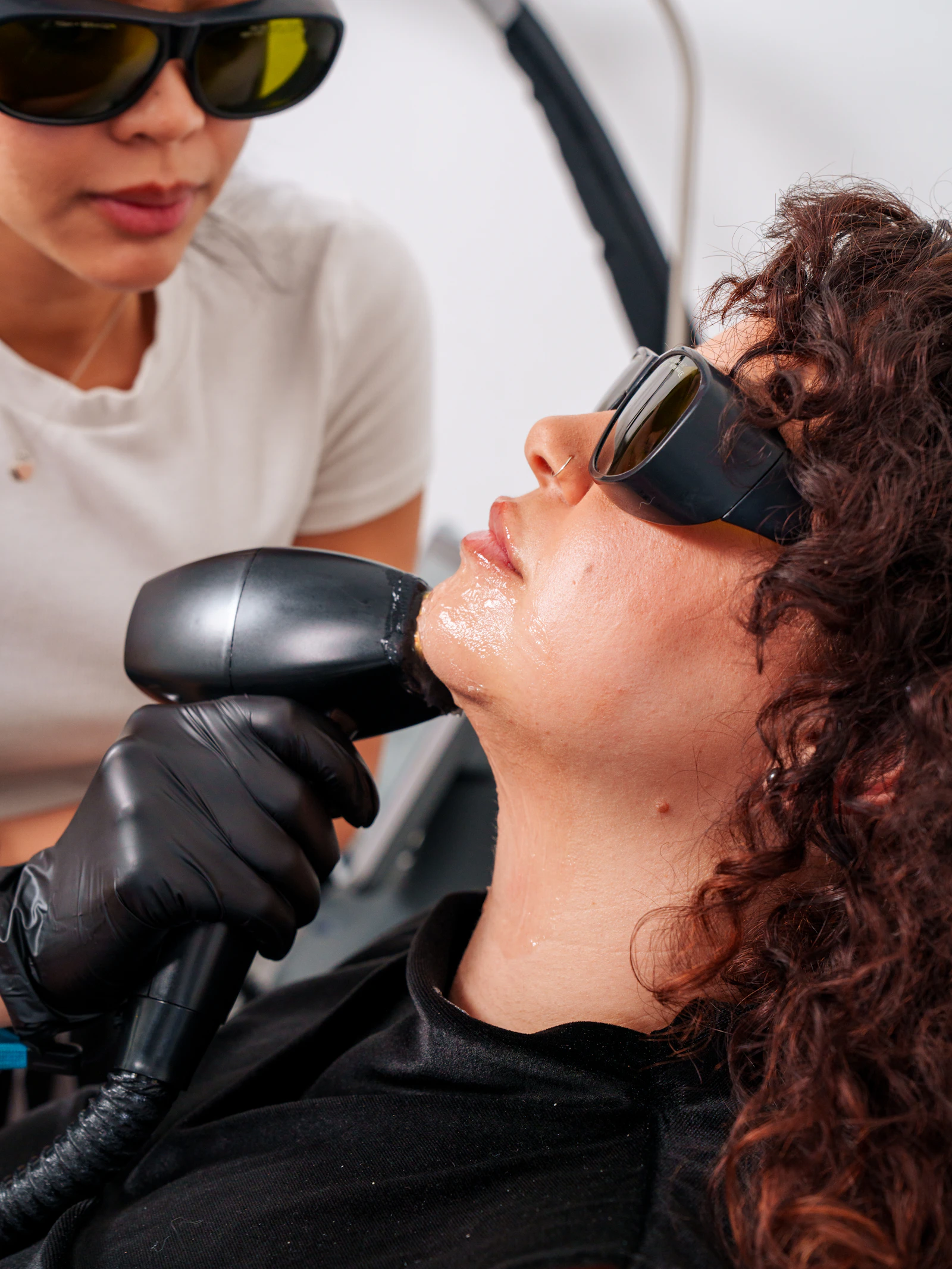
The sensation is often described as a hot elastic band snapping, stronger over thin or bony areas such as the upper lip, the underarms or the bikini line. Built-in cooling systems generally make it tolerable without anaesthesia. Numbing cream can be offered for sensitive areas.
After the session, redness and slight swelling around the follicles are normal and last from a few hours to two days. Treated hairs fall out gradually over two to three weeks, which can give the misleading impression of regrowth.
- Common contraindications: pregnancy, active skin infection or lesion in the area, a history of photodermatosis, recent isotretinoin treatment.
- Caution with a history of cold sores in the treated area, keloid scarring or pigmentation disorders.
- A mole is not treated with the laser: it is worked around.
- Rapidly appearing excess hair growth in a woman warrants hormonal assessment before starting sessions.

Frequently asked questions
How many laser hair removal sessions are needed?
Generally 6 to 10 sessions, spaced 4 to 6 weeks apart on the face and 6 to 10 weeks on the body. Hormone-dependent areas such as the face and neck in women often need more, followed by spaced maintenance sessions.
Does laser hair removal work on Black skin?
Yes, with an Nd:YAG 1064 nm laser, which interacts less with epidermal melanin and reduces the risk of burns and pigmentary marks. Alexandrite should be avoided on dark skin. Ask which device will be used and insist on a patch test on a small area first.
Why is it called long-lasting rather than permanent hair removal?
Destroyed follicles do not grow back, but dormant follicles can be activated by hormonal change such as pregnancy, menopause or polycystic ovary syndrome. The outcome is a very substantial, stable reduction with finer remaining hair, rather than total disappearance for life.
Can you have laser treatment on tanned skin?
No, it is not advised. Tanned skin holds more melanin in the epidermis, which absorbs energy meant for the hair: the risk of burns and pigmentary marks rises and efficacy falls. Wait for the tan to fade and avoid sun exposure between sessions.